Sibford Scene Archive

Sibford Scene 004 June 1977

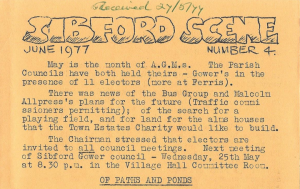
Click on the cover image to download the complete edition

A close up of text on a white backgroundA close up of text on a white background

Midsummer Day

Midsummer comes all too quickly on the heels of a late Spring. To many of us it is a reminder that the year is half spent and, perhaps, so little accomplished.

The summer solstice, June 21st, was a significant date in both pagan and early Christian times. Pre—Christian communities were small by modern standards and bound closely to the land, so it is not surprising that they were deeply concerned with the changing seasons. The lengthening or shortening daylight and the waxing and waning of the sun’s power were of the greatest importance in their cultivation of food crops. High and low ‘watermarks’ the longest and shortest days were invested with magical properties.

On Midsummer Eve spirits were abroad, both good and evil, and needed to be honoured and propitiated. Fires were lit to honour the sun, branches of fresh green trees adorned doorways, while men, women and animals wore sprays of herbs or plants to ward off evil. Among these was the plant known as St. John s Wort (Hypericum).

Early Christian compilers of calendars had the happy knack of marrying pagan feasts with Christian festivals. Midsummer Day was moved from the true date of the Solstice to the birthday of St. John the Baptist, June 24th. Who knows where his birth was registered?…..

By the 15th century the witches had begun to lose credence and St. John’s Eve was a time of more innocent merriment and dancing round the bonfires. The pranks and amusements of the workmen and fairies in “A Midsummer Night’s Dream” reflect Shakespeare’s knowledge of early festivals in Arden.

Who knows what Midsummer customs were observed in our villages? We are told that the Rollright Stones originated when a certain king from the South of England marched to the Midlands to conquer Mercia. On the Rowlditch Ridge he paused-to gaze over the Midland Plain but exchanged angry words with a local witch who turned both king and his followers into stone, and herself into an ‘eldern’ tree. On Midsummer Eve the King Stone bows to the ‘eldern’ tree.

What other local legends of fairies and Witches survive?

Geoffrey Law

The local charities

The Sibford Town Estates Charity and the Fuel Allotments Charity are both registered with, and controlled by, the Charity Commission. The governing instrument in both cases is dated 12th January 1922, and there are nine trustees, four nominative and five co-optative, who are solely responsible for administering the Charities. The beneficial areas are Sibford Gower and Burdrop.

These two Trusts emanate from a multitude of bequests of small parcels of land dating back, in some instances, hundreds of years. They were eventually assembled by the Charity Commissioners and substituted by Sibford Heath Farm and allotments, and the area known as the Fuel Lands. The incomes from these properties can be applied strictly to the named localities – the permitted distribution is one third to the relief and maintenance of the poor in Sibford Gower, one third to charitable and pious purposes and one third to local education. The whole Fuel Land income is applied to the distribution of fuel every winter.

Now that the responsibility for the relief of the poor has passed from Parish to the County and State, poverty has become a private matter between an individual and a Professional responsible for the new Social Services. Consequently, the Parish Trustees are now ill-informed, and at times unaware of, true poverty. And, indeed great care has to be taken that a Charity grant and/or award does not jeopardise any State aid. The Trustees are now faced with he dilemma – is anyone really poor if they take advantage of all the State services available?

However, the Village Trustees are always approachable, and any appeal for assistance will be dealt with fairly and sympathetically but it does not mean that the availability of funds guarantees a grant!

John C. Andrews (Hon. Sec.)

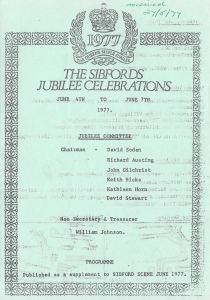
Above, you may see one or two items of historical interest from this edition. To see the whole edition, click on the front-page image to download it as a pdf.