(March 2026) Education in the Sibfords
Our Village School – Part 1 – Early beginnings
Sibford Gower Endowed Primary School, situated in the heart of Sibford Gower, has a long history and celebrated its 400th anniversary during 2025. The first recorded schoolroom was built in 1625 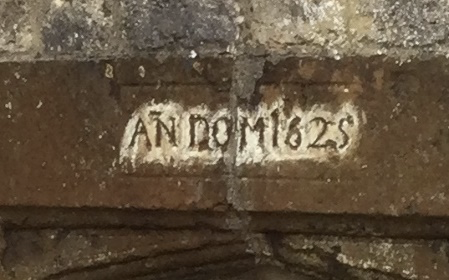 by the Sibford Gower Town Estate Charity and a date stone of that date is incorporated in the current school building. The charity was formed in about the year 1560 by a benefactor(s) whose name is unknown, for the benefit of the ‘poor of Sibford Gower’. Its beneficaries were to be – one third to the relief and maintenance of the poor, one third to the school and school master and one third to pious and charitable purposes. The charitable support for the school resulted in ‘Endowed’ being included in the name of the school. This endowment suggests that there was a school in existence, possibly in a private house, as far back as 1560 when the charity first started. The original documents relating the charity were thought to be lodged in London and may have been lost in the Great Fire of 1666.
The presence of a school in a small rural village to educate its children as early as the 16th century is exceptional, unusual and demonstrates an independent and free spirit among the peoples of the Sibfords. When the open fields were enclosed in 1774 for Sibford Gower, the plot surrounding the school was measured as 1 acre and 5 poles. The ground behind the school dropped away sharply into the Sib Valley making it ideal for sledge runs in the winter but making cricket, football or even gardening very difficult. Springs abound in this area and one emerges towards the bottom of the bank and feeds a pool. It has been known to generations of school children as ‘The Tite’ which has never been known to run dry and has supplied a continuous source of water to the school and village alike until mains water was installed in 1935. The size of the outlet pipe and the volume of water delivered in a given time has provided practical measurements for many mathematical calculations for generations of pupils!
By 1825 the schoolmaster was offered a house on Main Street opposite the school which was owned by the charity. The boys were taught reading, writing, and arithmetic and worked in the garden and orchard. While the boys worked outdoors, the girls were taught knitting and sewing by the school master’s wife. By 1879, the subjects taught were extended to include religious knowledge and singing, and the girls and infants were given instruction in needlework. By 1893, grammar was taught throughout the school and geography had been introduced for the boys.
Maureen Hicks