(July 2026) Our Village School – Part 5
The Second World War passed with little comment in the School Log book. On the day war was declared on July 28th 1939, there was no mention of the national news but 28 children were evacuated from Bow in East London to Sibford with their teacher. They had some of their lessons in the Friends Meeting House. Some children were billeted with local families while others slept in the attic area in the Friends Mission Room. The increased numbers of pupils meant that school lunches were taken in the Old Village Hall behind the Wykham Arms. Many lasting friendships were made with local families. School was closed for one day on 8th May to celebrate VE Day in 1945 and by 1946 the last evacuee is reported to have either left the village and returned to London or, because some had so enjoyed their time in the countryside, some remained and found alternative housing in the local and surrounding villages.
Childhood immunisation against diphtheria was introduced and the general health and well-being of the schoolchildren gradually improved. School nurses visited and recorded the height and weight of the children while dental inspections and treatment improved the dental health in the post war years.
The introduction of the Education Act in 1944 recast the whole of the educational system. The Board of Education was replaced by a government minister who was to direct and control local education authorities throughout England and Wales to ensure a more even standard of educational opportunity. By 1948 our village school formed a Parent Teacher Association and more contact with parents became established – something which has continued and flourished ever since. The educational teaching and learning was taken over by the Oxfordshire County Council in 1951 but the buildings and land remained in the ownership of the Town Estate Charity.
By 1953 pupil numbers started to rise again with 64 on roll and in 1954 a third teacher took over the reuse of the third classroom with a class of fifteen pupils. However, the heating in school was still inadequate – 4.5 degrees Centigrade in January 1956 and there were still bucket lavatories. Flush, indoor lavatories were completed in 1957, much to the joy of the caretaker, when a sewage system was completed for the village.
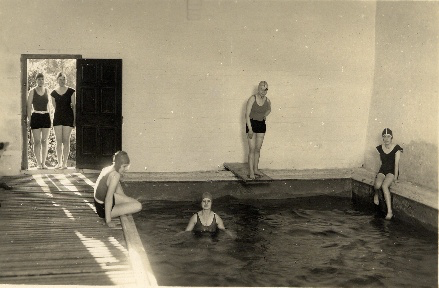 Improved relationships between Sibford School and the village school resulted in benefits for both. Older pupils from the Friends School interested in working with children as teachers or in other capacities, spent time in the village school while the shared use of the heated swimming pool meant that a high percentage of the village children left the primary school each year able to swim at least 10 yards.
Maureen Hicks