Swifts 2025
Blog
Thu 1 May, box #1: Our first swift of the 2025 season arrived this evening at 7.23pm, presumably the same bird that spent last year’s season mostly roosting alone, without breeding. It did have a partner for a few nights just before emigrating last year, so perhaps they will be a productive pair this year.
Sun 4 May, box #4: Our second swift arrived at 6.07 this morning, presumably the same bird that had a traumatic 2024 season, having fights with its partner, laying four eggs of which only two hatched, then losing its partner to the kestrel and finally losing a hatchling that took a suicidal leap out of the box.
Mon 5 May: We saw two birds in #1 for a few minutes in the morning, but only one roosted. Later on, we saw two birds in #4, roosting together; we suspect that the new bird is the same one that visited #1 this morning.
Tue 6 May: One bird roosting in each of boxes 1, 2, 4 when the cameras switched off at 11pm.
Wed 7 May: When the cameras came on at 5am there were two birds in #1 and none in #2. Tonight, just one bird roosting in each of 1 and 4.
Fri 9 May: A swift arrived in #3, the first time this box has been occupied this year. I saw a group of 9 overhead this evening.
Sun 11 May: Over the weekend three more swifts have arrived and today ended with pairs in each of #1, #3, #4. We have seen a swift briefly in #2 on several occasions, but not roosting.
Tue 13 May: It looks as if last year’s singleton in #1 has partnered with the widowed bird that was in #2. There’s been a lot of coming and going in #2, with never more than two birds total in #1 and #2, and a pair roosting in #1 every night. Last year’s camera footage seems to show that they partnered up at the end of the season, roosting together in #1 for three nights after #2’s last chick was taken by the kestrel, before emigrating together.
Wed 14 May: Today we installed an external camera recording visits to the 7-box “hotel”, and it has caught a swift visiting box #h5.
Thu 15 May: #2 remained empty all day. Things seem to have settled down to three stable pairs in #1, #3, #4 which we can expect to breed. It’s not too late for newcomers to take up residence in #2 and breed, so fingers crossed.
Sat 17 May: An egg was laid in #1 early this morning.

Tue 20 May: Now an egg in each of #1, #4, and two eggs in #3. Box#2 remains empty, but we have seen some “knockers” taking an interest in the colony – these are swifts prospecting for a nesting site by flying up to a box to check if it is occupied, but not entering.
Wed 21 May: A couple of nest boxes were installed on Holy Trinity Church in time for this year’s season, and last week I installed a sound system to attract swifts by playing recorded swift calls morning and evening. It was gratifying to be told today that swifts have been seen taking an interest in the boxes.
Sat 24 May: The egg situation has not changed in the last two days: 3 in #3, 2 each in #1, #4, with #2 remaining unoccupied. #3 have settled into serious incubation now that they have reached the usual maximum clutch size, rarely leaving the eggs uncovered. The other pairs are still out together for long periods. Swift eggs can tolerate being cold for long periods; their development is simply held back, so that all the eggs hatch at about the same time and the hatchlings are well-matched when it comes to competing for food.


Meanwhile, round the corner in the hotel, a pair has occupied #h5 all week, coming and going together so, although they my have eggs, they have not started serious incubation yet.

The bad news today is that the kestrel, or one of its ilk, that took 5 of our swifts last year is back:

This prompted us to install an awning over the entrance in the hope that it would both obstruct the kestrel’s view of the entrance and make it difficult for them to hang on while probing it with a claw.

The awning is made from 150mm x 9mm UPVC board, 300mm wide, 90mm high and 120mm deep. We initially positioned it with the bottom edge in line with the top of the entrance. Unfortunately, although we installed the awning late in the evening after checking that both swifts were in, it turned out that one swift was out and did not roost that night.
Sun 25 May: The #3 missing swift returned at dawn and made over 100 passes before going in; after that both birds seemed to have accepted the awning and came and went as normal. However tonight one of the #1 pair did not roost (no awning on their entrance!).
Mon 26 May: Today we moved the #3 awning up about 15mm. We installed an awning on #4 at the same level and that pair got used to it very quickly. We’re getting concerned about #1 as one swift is still missing – did the kestrel get it, unnoticed by us?
Tue 27 May: The unoccupied #2 was visited by a pair this morning; one went straight to the nest cup and made itself at home while the other had a look around. They arrived together and left together after 13 minutes and haven’t been seen again. Weird!
Much to our relief, the missing #1 swift returned at 9pm and roosted.
Here’s a thought – while #2 was being visited this morning, #1 was empty. Recalling that the #1 pair seemed to have difficulty a couple of weeks ago in choosing which box to nest in, could it be that the visitors were actually the #1 pair?
Wed 28 May: Rather depressing to see that the kestrel is not at all put off by the awnings – but it didn’t catch anything:
Fri 30 May: No excitement yesterday or today, just three pairs each dutifully incubating three eggs. The first hatching should be within the next two weeks.
Sat 31 May: I have had a caller running for the last 3 weeks or so near the two nest boxes that were installed this year on Holy Trinity Church in Sibford. A week later a keen-eyed villager told me that she had spotted several swifts taking an interest in become tenants, so it was delightful today to notice, as I walked past the church, that there were swifts in residence. I saw one bird fly in and out of one box several times; at one point, from within the box, it was exchanging calls with a swift in the other box.
Sun 1 June: Somewhat obsessively, I have been reviewing last week’s footage from the camera that monitors our “hotel” apex box (no cameras inside), and noting the times of swift arrivals and departures of the pair that is nesting in box #h5. On Wednesday they left the box empty for over 10 hours of 24, but on Saturday that was reduced to 18 minutes. This is surely a sign that they are now seriously incubating an egg or three.
Tue 3 June: Today, more evidence that the occasional visitor(s) to #2 are in fact the #1 pair. In the video sequence below, we see a swift entering #2 with a feather in its beak; it looks around and then leaves. Ten seconds later a swift enters #1 and we glimpse sight of a feather in its beak.
Sun 8 Jun: #3 has moved on to the next stage: two chicks hatched today:
Not such good news: one egg was accidentally displaced from the nest in #4:

Mon 9 Jun: Third chick hatched in #3.
Tue 10 Jun: First chick hatched in #1.
The kestrel is back. It made a couple of attacks on #4 and 40 minutes later on #1, which has no awning (yet), all without success:
Wed 11 Jun: Second hatching in #1.
Installed a Mk2 awning on #1; although all the birds were in their boxes by then, one from #3 may have been perturbed by the installation noise, as it spent the night out of the box.
Thu 12 Jun: First hatching in #4.
There are more swifts about today – the most we saw at one time is ten. An intruder into #1 was seen off rather smartly:
Fri 13 Jun: Last two eggs hatched in #1 and #4 today, giving us a total of 8 chicks.
Sun 15 Jun: The kestrel has been about again today, making speculative attacks on a couple of the entrances. However, we seem to have an ally in the form of a volunteer Corvid Defence Force. The kestrel enters top left to perch on the gable peak for a moment (best watched with audio turned up):
Mon 16 Jun: Sadly, last night one of the chicks was ejected from #1 nest cup by one of its siblings when the parents were both out. It looked as if it was an unfortunate accident, partly due to the victim being somewhat smaller than its siblings. However, by the end of today it was somehow back in the nest and being fed.
It seems that a whole new wave of swifts has just arrived. We’ve had a couple of proper screaming parties swooping around last night and this morning, exchanging calls with the resident birds and “banging” on the entrances. Not a huge number, though – perhaps half a dozen birds.
Sat 21 Jun: Round the corner from our main colony, there was a notable change in the behaviour of the one resident pair. They have been incubating for the last couple of weeks, as indicated by their never leaving the box completely unoccupied. On Thursday this week they were both out for a little over an hour in total and on Friday 2½ hours. They have also increased their activity, as measured by counting how many times a swift leaves the box on a feeding expedition. Up until last weekend it was 10 times per day or less, but from Tuesday it has been around 20 – surely a sign that they need to collect food for chicks as well as themselves.
Thu 26 Jun: Following another (unsuccessful) kestrel attack on Tuesday, today we upgraded the baffle on #3 to the Mk3 version. This photo shows the original (Mk1) baffle on #4 (bottom right), the Mk2 on #1 (top left) and the Mk3 on #3. Box #2 (top right) is unoccupied.

Fri 27 Jun: This is the first day that we have seen chicks exercising their wings. Here are 2-week olds in #1 and #4. It’ll be about another 4 weeks before they fledge, late July.
Fri 11 July: The kestrel took two chicks today, one from #1 and one from #4. The video switches to slow motion part way:
Thu 17 July: A few days earlier than expected, our first fledging was from #3 at 21:51 this evening.
Sat 19 July: A second chick fledged from #3 at 21:59. The third went into the tunnel at about 22:50 just before the cameras went off and probably fledged soon after that; it was gone when the cameras came on again at 4am.
Sun 20 July: The kestrel took the remaining chick from #4 at 19:12.
Mon 21 July: A fledging from #1 at 09:11. The score for our 8 chicks is now: kestrel 3, fledged 4, leaving one about to fledge from #1. We’re on constant watch for the kestrel during the day. We have a bit of hi-tech help from a camera monitoring the kestrel’s favoured launchpad at the top of the electricity pole; after some image analysis by ChatGPT a siren is sounded in the house when a kestrel is recognised (rather than a crow, pigeon or squirrel). It then only takes a knock on the cedar cladding to send any chicks scuttling out of the tunnel where they are vulnerable and back into the nestbox.
Wed 23 July: Although all three chicks from #3 have fledged, the parents are still roosting there. In #4, on the other hand, one of the parents has been gone for the last two nights.
Thu 24 July: Our last chick fledged successfully at 12:06 today, launching itself into its true home, the sky, where it will live for the next 2 years or so until it returns to breed for the first time. The video is slowed by a factor of four:
But what of the one occupied box in the “hotel” around the corner? We know from counting their comings and goings on the external camera footage that they have been feeding chicks, which we think hatched about a week after those in the main colony. There’s still a lot of counting to do; watch this space for news.
Mon 28 July: Two chicks fledged from the only occupied box in the “hotel” late last night, at 21:43 and 21:53. The parents left within seconds of each other this morning and did not return. In the clips below, notice the contrasting flying styles of fledglings and adults as they leave the box.
In summary for the 2025 season, 4 boxes were occupied, 11 eggs were laid, of which 10 hatched. Three chicks were taken by the kestrel, but 7 fledged successfully and all adults survived.
Temperature chart
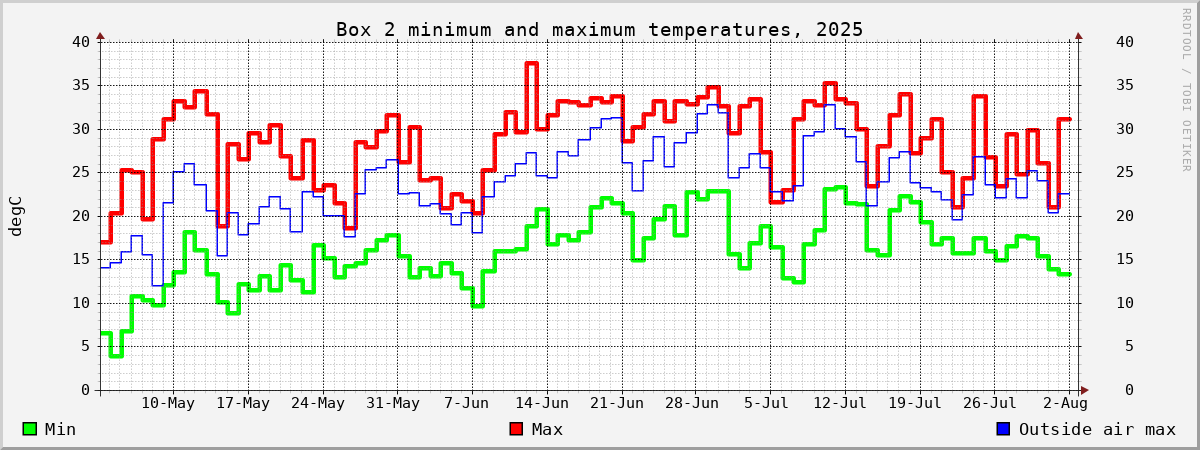
This chart shows the maximum and minimum temperatures in box #2 this summer. Box #2 is usually the one that gets warmest, being inside the top west corner of the gable end.